


Government Urged to Improve Public Expenditure and Service Delivery



Kathmandu, — Minister for Industry, Commerce and Supplies Anil Kumar Sinha has highlighted growing public dissatisfaction due to unplanned and ineffective use of government resources. He spoke at a policy dialogue on improving public expenditure and service delivery organized by the Society of Economic Journalists Nepal (SEJON) today.
Minister Sinha emphasized that public trust in the state is weakening as government expenditure is often made without analyzing plans, priorities, and expected outcomes. “Dissatisfaction among citizens naturally increases if public resources are not properly utilized and economic good governance is not maintained. The Gen Z protests on September 8 and 9 are a recent example of this dissatisfaction,” he said.
The Minister stated that the government is committed to ending black marketing, monopoly, and artificial shortages in the market. However, he admitted that structural and implementation limitations have slowed the pace of government initiatives despite the commitment to good governance, transparency, and financial discipline.
Structural Concerns in Public Spending
Financial Comptroller General Shobakant Poudel pointed to structural problems behind ineffective public expenditure, noting that funds are often spent in unproductive sectors. “There is no political stability, and the structures governing social security expenditure have not been reviewed,” he said.
Poudel also criticized the private sector’s hold on project licenses, noting that despite privatization and economic liberalization, power and resources remain concentrated in the hands of a few individuals and institutions. He stressed that the interim government formed after the Gen Z uprising has reduced unnecessary expenditure, but political leaders and bureaucracy must deliver with high morale and responsibility.
Suresh Pradhan, member of the Public Expenditure Review Commission, voiced concern over the absence of clear criteria for public spending. He explained that budget formulation lacks transparency, standards for allocation are undefined, and delays in project completion persist due to ad hoc decision-making and unclear divisions of responsibility among government agencies.
Youth entrepreneur Vedika Murarka highlighted the importance of radical reforms in public service delivery, stating that economic transformation is not achievable without investment that fosters innovation and new ideas.
Economist Dr. Dilli Raj Khanal criticized the weak effectiveness of public expenditure, noting that many boards, committees, and institutions fail to deliver outcomes. Despite incentives provided to the manufacturing sector, expected results have not been realized. He added, “Nepal remains one of the weakest countries in South Asia in terms of poverty, per capita consumption, and living standards. Efforts to improve public expenditure administration are insufficient, and significant improvements in service delivery are lacking.”
Call for Result-Oriented Governance
Across the dialogue, speakers unanimously stressed that public expenditure must become more transparent, accountable, and result-oriented to address widespread inefficiencies. The event highlighted that improving service delivery through effective allocation of resources is both a pressing challenge and an opportunity for the government.
He added, “It is our responsibility to hand over administration with clear improvements in governance and service delivery ahead of the upcoming elections.” Sinha also explained that the interim government has cut down certain projects that were previously incorporated into budgets based on access to power rather than necessity. He emphasized the need for digital technology, human resource management, prioritization of spending, and result-oriented allocation to improve public services.
Trending
-
The Ulsan College International Student Union to Host Sports Day Event on May 5, 2026
-
Kangwon National University Strengthens Ties with Nepal through SD Miracle Partnership
-
Zoccer – przegląd i dostępne opcje dla polskich graczy
-
Fee Disparities Found Among Nepali Students Going to South Korea for Study, Embassy Urges Caution
-
Protests Erupt Against Decision to Evict Squatter Settlements


Related Content
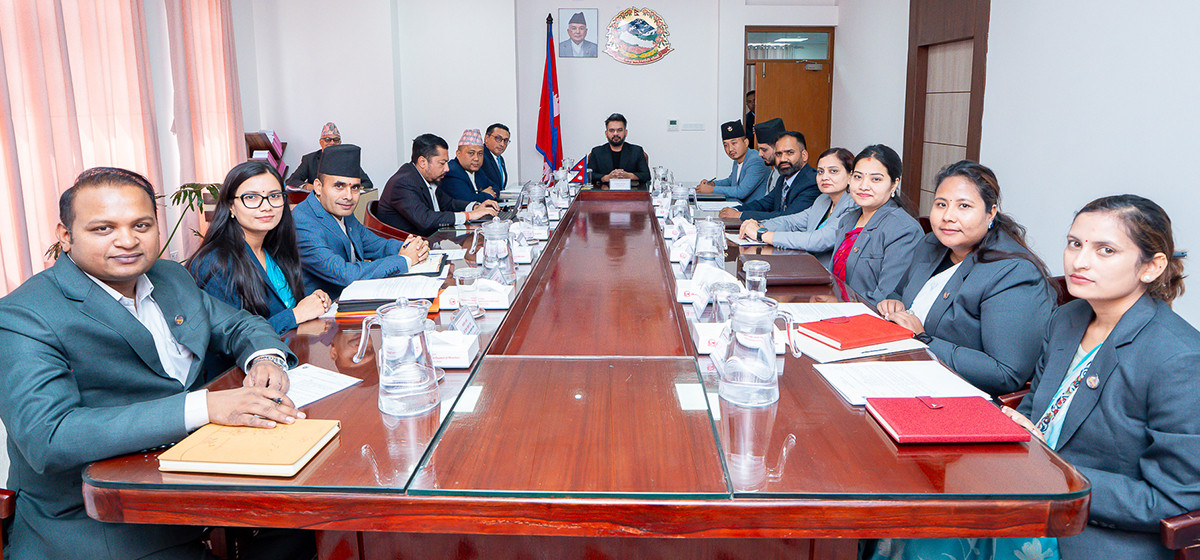
Government Recommends Six Ordinances to President
The government led by Prime Minister Balendra Shah has recommended six ordinances for approval to President Ram Chandra Poudel...
Nepali Congress Gives One Week for Membership Renewal
The Nepali Congress has given one week to districts and constituencies that have not yet entered membership renewal fees...
Opposition Parties Urge President Not to Approve Ordinances
Opposition parties, including the main opposition, have urged President Ram Chandra Poudel not to endorse the ordinances recommended by...

Mahesh Basnet Criticizes Proposal to Abolish Trade Unions and Student Bodies
Mahesh Basnet, secretary of the Communist Party of Nepal (Unified Marxist–Leninist), has strongly criticized the idea of abolishing trade...